
JVAB Saves Energy and Money at Its Construction Site
Scope 2, sustainability reports, and carbon footprints. New terms and complex acronyms used to explain something so simple: if we save energy, we have less of an impact on our environment and our wallets. JVAB dared to test our pilot project: our building automation system at a temporary facility. The result after just two weeks during a winter month: a 13.24% savings.
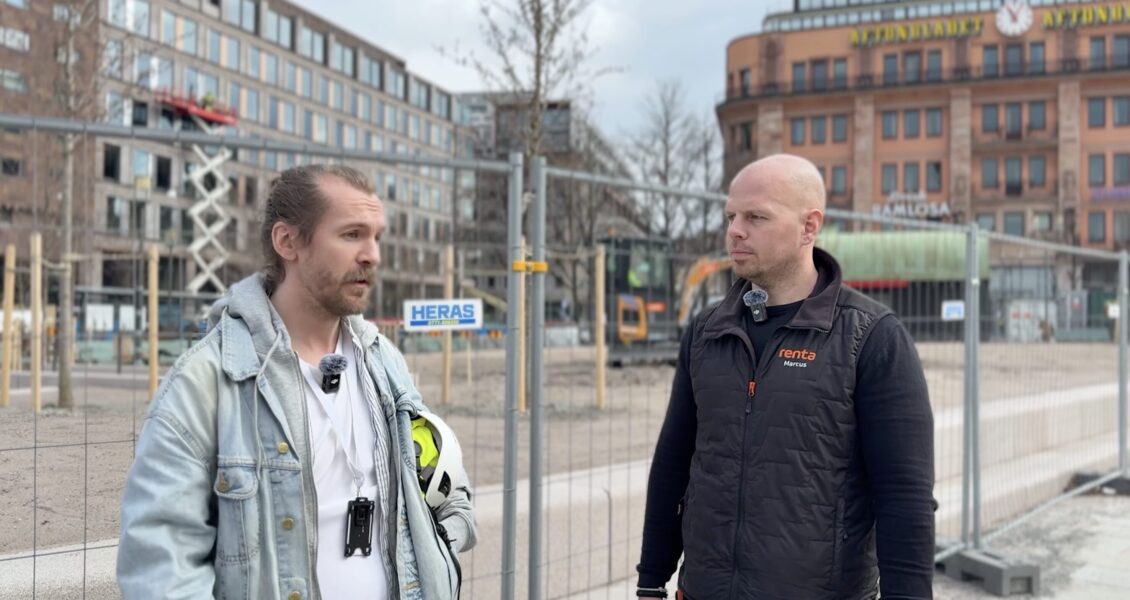
The birds are chirping, the bees are buzzing, and chlorophyll—the “blood” of plants—fills every park with greenery. Summer is just around the corner in Stockholm as we meet up with Peder Winblad, sustainability coordinator at JVAB, outside their project site down at Tegelbacken. Here, we’ve carried out a pilot project together with the goal of saving energy. Over the winter, we installed sensors, measured humidity, remotely controlled the air source heat pumps, and regulated the indoor climate to target temperatures—all to save energy without disrupting the work team on site. After the first two weeks, we had achieved a 13.24 percent savings. The project is still ongoing, and we’ll report back with the final results. Like all other organizations, JVAB faces financial pressures to reduce its expenses, while also having the requirement and goal of reducing its environmental footprint.
“It’s not about me coming up with a bunch of guidelines for our supervisors or about us radically changing the way we work. Rather, it’s about finding smart solutions that are good for both our wallets and the environment.” It’s actually pretty simple: if we use less energy, we also reduce our environmental impact and save money,” says Peder Winblad, sustainability coordinator at JVAB.
Sensors that can be monitored and controlled in real time
What was important to us and JVAB in this pilot was to compare two similar site facilities during the same time frame. In Kungsängen, JVAB has a site that we only monitor as a reference, and at Tegelbacken, they have a similar site where we monitor energy consumption. As for the temperature, during the workday it is 21 degrees, and after work hours it is 17 degrees inside the site offices at Tegelbacken.
– Every kilowatt-hour saved is a win. If we optimize energy consumption at our facilities, it’s good for both our wallets and the environment. We’re a society in need of change. There’s nothing negative about this. The results are very promising—13.24 percent without even having to take drastic measures. We’re saving a lot of money and reducing our energy consumption, says Peder Winblad.
Could Become the New Industry Standard—A Possible Step Forward for JVAB
Supply and demand drive all development, and this service is no exception—we’ve now tested it and received positive results early on. It’s always the customer who decides which of our solutions they want to rent. Peder sees the value in the service and believes that, in the long run, it could become part of a more standardized setup.
“At least, that’s my hope. I want us to have this in all our locations, and it should be profitable to do good things for the environment. It can be incredibly simple if done the right way, and you’re leading the way here. Kudos to Renta,” Peder concludes.